The best AI voice enhancer in 2026 — six tools, graded, no curve
By the ClarityGrade markers' desk · Grades computed by our published rubric · Some links are affiliate links (marked) and never move a grade
Every price and limit on this page verified 2026-09-20
Short version: Auphonic (A−, 89.5/100) is the best AI voice enhancer for most people — the widest cleanup scope in its class, honest public pricing, and 2 free hours every month to prove itself on your own audio. iZotope RX 12 (B+, 81.0) is the pick when the recording matters more than your weekend. Everything else this term sits in the C range, and the reasons why are the most useful part of this page.
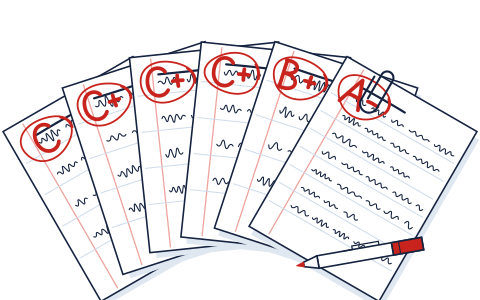
We grade enhancers the way an examiner marks term papers: same rubric for everyone, working shown, margin notes included. Five criteria — cleanup scope, control, workflow, value, transparency — weighted and computed by a script whose output we paste without touching. The full method, including why we refuse to invent listening-test scores, lives on How We Grade.
The grade board
Rank
Tool
Best for
Entry price (verified 2026-09-20)
Score
Grade
1
Auphonic
Most people, most recordings
Free 2 h/mo; one-time credits from $12 for 5 h
89.5
A−
2
iZotope RX 12
Professionals and stubborn damage
Elements $99 · Standard $399 · Advanced $1,399 (perpetual)
81.0
B+
3
LALAL.AI Voice Cleaner
Stripping music beds and noise from speech
10 free preview minutes; 750 min for $50 one-time
65.5
C+
4
ElevenLabs Voice Isolator
Fast one-shot rescues
~10 free min/mo; Starter $6/mo ≈ 30 min
62.5
C+
5
Waves Clarity Vx
Real-time denoise inside a DAW
Inside Waves Essential, $14.99/mo or $149.99/yr
62.0
C+
6
Async Magic Dust
One-click cleanup if you already live in Async
Essentials $19.99/mo or $143.90/yr (third-party listed — see review)
59.5
C
First, the definition — what an AI voice enhancer actually is
An AI voice enhancer is post-production software: it takes a recording that already exists and uses trained models to separate the voice from everything you did not want — room noise, air-conditioning hum, reverb, a music bed — and often to fix the voice itself, evening out levels and nudging loudness toward broadcast norms. The input is a file; the output is a better file.
That definition carries the category's one hard limit, so we will say it before any ranking: an enhancer cannot help you during a live conversation. If your problem is the dog barking through tomorrow's client call, you need real-time noise cancellation, which is a different species of software with a different set of names. We keep a short, plain guide to the boundary between the two categories, including what we point to on the live-call side.
Within the category, the tools split three ways, and knowing which species you are buying prevents most bad purchases:
One-button tools (ElevenLabs Voice Isolator, LALAL.AI, Async's Magic Dust) — a single pass, minimal choices, speed as the selling point.
Editor-grade suites and plugins (iZotope RX 12, Waves Clarity Vx) — maximum control, operated inside an editing environment you must already own or learn.
The three species, with this term's grades
Processing services
Auphonic
One-button tools
ElevenLabs Voice Isolator
LALAL.AI Voice Cleaner
Async Magic Dust
Editor-grade suites and plugins
iZotope RX 12
Waves Clarity Vx
Every one-button tool on the board landed in the C range; the two species that expose decisions took the only A− and B+.
1. Auphonic — A− (89.5/100): the one that shows its working
Auphonic has been doing "AI post-production" since before the phrase was fashionable: an adaptive leveler, noise and reverb reduction, automatic EQ, and loudness normalization to whatever target your platform wants. What earns the grade is not any single algorithm but the temperament of the thing — every correction is a setting you can see, strength-adjust, preset and batch, not a sealed guess. Two hours of processing are free every month (free productions carry an Auphonic jingle), one-time credits start at $12 for five hours and never expire, and the S subscription is $13/month for 9 monthly hours ($11/month billed yearly). Every one of those numbers is on one public pricing page, which is exactly the transparency this category otherwise lacks.
The half-letter it lost: no dedicated mouth de-click or plosive surgery — genuinely damaged audio still needs RX — and long-form workloads eventually make the hour-metered pricing add up. Full margin notes in the Auphonic review.
Direct link, no affiliate relationship: auphonic.com. Our top grade pays us nothing, which is how you know it is a grade.
2. iZotope RX 12 — B+ (81.0): the surgeon's kit
RX is what post-production professionals actually open when a recording is damaged rather than merely imperfect: dialogue isolation, de-reverb, de-click, de-plosive, spectral repair — fifty-plus tools in the Advanced tier, each with real parameters and previews. On scope and control it scored perfect fives; nothing else we graded comes close. The grade drops on workflow and value: it is a desktop suite with a real learning curve, and while Elements at $99 is a fair door price, the tier most voice work wants is Standard at $399 (Advanced runs $1,399). Note for buyers in late 2026: the brand has changed corporate hands again (Boris FX), which we flag not as a defect but as a reason to buy the version you need today rather than a roadmap. Details in the RX 12 review.
Direct link, no affiliate relationship: izotope.com.
3. LALAL.AI Voice Cleaner — C+ (65.5): the music-bed specialist
LALAL.AI built its name on stem separation, and its Voice Cleaner inherits the useful half of that trick: it pulls speech out of background music, noise, rumble and plosives with less smearing than most one-button rivals when the contamination is musical. Ten preview minutes are free, and the one-time Master pack — 750 minutes for $50, about $4 per processed hour — is honest pricing with no subscription hostage-taking. It stays in the C range because it is still a black box: no strength dial, no per-problem modules, and no leveling or loudness work at all, so it cleans your take and hands you back a file that still is not finished. Voice Cleaner review.
4. ElevenLabs Voice Isolator — C+ (62.5): the fast rescue
Drag a file in, get the speech back out with the noise and music stripped — that is the whole product, on the web or through an API, billed at 1,000 credits per minute of audio. The free tier's 10,000 monthly credits buy you roughly ten minutes, and the $6 Starter plan about thirty, which makes it the cheapest way on this page to rescue one important voice memo. It is also the purest example of the category's central flaw: one shot, no dials, take the result or leave it — and at roughly $12 per processed hour on paid credits, heavy users will find Auphonic's maths friendlier. Voice Isolator review.
Affiliate link — commission possible, grade unaffected: try Voice Isolator.
5. Waves Clarity Vx — C+ (62.0): the plugin with one big knob
Clarity Vx is a genuinely good AI denoiser that lives inside a DAW, runs in real time, and is operated mostly with one large knob — turn until the noise is gone, stop before the voice goes with it. If you already edit in a DAW and already hold a Waves subscription, it is an easy recommendation. The grade reflects everyone else's reality: the product page today sells it only inside Waves Essential ($14.99/month or $149.99/year) or Ultimate ($24.99/month), and a rolling subscription for a single denoise knob is hard maths — while the standalone-purchase question is simply not answered on the page. Clarity Vx review.
Affiliate program exists (application-gated); link routes via our /go/ redirect and is disclosed either way.
6. Async Magic Dust — C (59.5): one click, many caveats
Magic Dust is the "make it sound like a studio" button inside Async, the browser production suite that was called Podcastle until February 2026. As a feature it is fine — noise down, levels tamed, one click — and if you already record, edit and publish in Async, it is effectively free with the suite. As a purchase it earned this term's transparency note: the vendor's own pricing page renders dashes unless JavaScript loads the numbers, so the figures buyers rely on (Essentials $19.99/month or $143.90/year; free plan capped at 10 lifetime AI credits) had to be confirmed through third parties. We wrote up the rebrand's loose ends separately. Magic Dust review.
Direct link, no affiliate relationship: async.com.
What we did not grade, and why
Three absences worth explaining, since sharp readers will notice them:
The famous ones. Adobe's Enhance Speech, Descript's Studio Sound and the big-name suppression tools are reviewed to exhaustion everywhere else on the internet. Our desk exists for the enhancers that get less scrutiny; adding a seventh take on tools with a hundred reviews would teach you nothing.
ai-coustics. We planned to grade it. By our verification date the company had pivoted to voice-agent audio infrastructure — SDK products named Quail, Tyto and VAD — with no consumer enhancement app or public pricing on the site. We grade only what a reader can actually buy today.
The departed. Accusonus' ERA bundle, once the obvious budget pick, has been gone since the Meta acquisition. It appears in our margin notes as history, not as advice.
Recordings are half the problem. Calls are the other half.
Most people search "AI voice enhancer" after a recording went wrong. Fair enough — the six grades above are the repair options. But if the recording that went wrong was a meeting, understand that no enhancer will be standing next to you during the next one. That job belongs to real-time noise cancellation, and it is the one recommendation on this page from outside the enhancer category.
For live calls: Krisp
Krisp removes background noise from both sides of a call as it happens — your mic and their speakers — across whatever meeting app you use. Verified 2026-09-20: 7-day free trial without a credit card, then the Core plan at $8/user/month billed annually ($16 month-to-month) with unlimited noise cancellation. It is the standing answer we give when someone asks an enhancer to do a suppressor's job.
Marked link: subscribe through it and Krisp may pay ClarityGrade a commission. Krisp is not graded on this page: it is not an enhancer, and we do not grade categories we monetize differently. Disclosure.
How to choose in ninety seconds
One bad recording, this week, no budget: ElevenLabs Voice Isolator's free ten minutes, or Auphonic's free two hours if you also want levels and loudness fixed.
A recurring show or lecture series: Auphonic, with a preset, on the S plan or one-time credits. This is the category's best working answer.
Speech buried under music or heavy noise: LALAL.AI's one-time 750-minute pack before any subscription.
Damaged audio that matters professionally: RX 12 — start at Elements ($99) and find out whether you are an RX person before paying for Standard.
You edit in a DAW daily: Clarity Vx inside a Waves subscription you would hold anyway.
You want recording-to-publishing in one tab: Async, with eyes open about the pricing-page habits noted above.
Your real problem is live meetings: none of the above — Krisp (affiliate link, disclosed).
Questions we get in the margins
Can an AI enhancer fix a truly terrible recording?
Sometimes, partially. Models reconstruct plausible speech, and "plausible" degrades as damage grows — push any of these tools hard enough and you get the robotic, underwater artifact everyone recognizes. Our workflow guide covers the honest checklist: when to process once, when to lower your ambitions, and when to re-record.
Why did nothing score an A?
Because the rubric pays for control and transparency, and the category is still allergic to both. The day a one-button tool ships a strength dial, per-problem toggles and a public per-hour price, the A is waiting. The full argument is on How We Grade.
Is there a catch to the free tiers?
Read each tool's terms: Auphonic stamps a jingle on free productions, ElevenLabs' free credits exclude commercial use, LALAL.AI's free minutes are previews in a slower queue, and Async's free plan is 10 AI credits lifetime, not monthly. All four details are in the reviews, verified 2026-09-20.
Enhancer or a better microphone?
If you control the room and the budget, better capture beats better repair — no enhancer out-performs not needing one. Gear is outside our syllabus, so you will find no microphone recommendations here; we only note the honest ordering.
How current is this page?
Every price, limit and plan name above was checked against the vendors' live pages on 2026-09-20, and the date gets refreshed when we re-verify. If a vendor changes pricing between our checks, their page wins — tell us and we will re-grade.