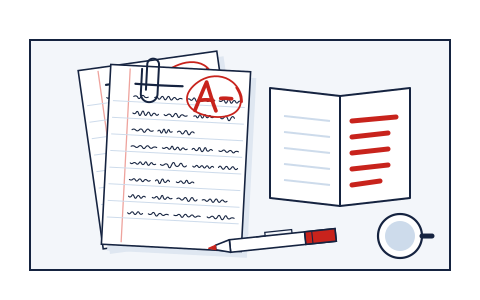
ClarityGrade grades AI voice and audio enhancers the way an examinations board marks papers: one published rubric, weighted criteria, computed totals, and margin notes that tell each tool exactly where its points went. We cover the enhancer category — software that repairs recordings after the fact — and nothing else, except one clearly labeled signpost to the live-call category next door.
Why a team byline
Everything here is signed "the ClarityGrade markers' desk" rather than with individual names and portrait photos. The honest reason: invented reviewer personas with stock-photo faces are this industry's oldest trick, and we would rather give you no names than fake ones. The desk's credibility is designed to live somewhere checkable instead — in the published rubric, the scoring script whose output we paste unedited, the verification dates on every price, and the visible fact that our top grade carries no affiliate link.
The rules we mark ourselves against
- Computed, not composed: every score and letter comes out of the scoring script. If a number on a page cannot be reproduced from the rubric, it is a bug, not an opinion.
- Docs-based claims only: we grade what vendors document, charge and demonstrably ship. We do not publish listening-test percentages we did not produce, and we say plainly when a judgment call enters a factor score.
- Dated facts: any page stating a price or limit shows the date we verified it against the vendor's live page. Stale dates are a defect — report them.
- Disclosed money: affiliate links are marked inline, routed through visible
/go/URLs, and attached only after grades are computed. Vendors with no program are labeled "no affiliate relationship." The full policy is in the fine print. - Limits admitted: enhancers cannot fix live calls, heavy damage defeats every tool we cover, and better capture beats better repair. Pages repeat these truths even where they cost us a sale.
What we deliberately do not cover
Hardware — microphones, interfaces, acoustic anything — is outside the syllabus entirely; when capture advice matters we say "better capture wins" and stop. Real-time meeting tools are next door's category: we keep one boundary guide and one disclosed recommendation, and grade none of them. And the enhancer tools every other site already reviews at length get passing mentions at most; our seats go where scrutiny is scarce.
Corrections
If a price has moved, a factor score reads unfair against the cited docs, or a vendor shipped the feature we said was missing — write to [email protected] with a link to the evidence. Corrections that survive checking get applied, re-scored where relevant, and noted in Red Ink. Being correctable in public is most of what "independent" means.
The short version: a rubric you can read, scores you can recompute, prices you can re-verify, and money you can see. Grade us on that.